
 Greg McFarquhar University of Illinois
Professor Greg McFarquhar Department of Atmospheric Sciences University of Illinois 105 S. Gregory Street Urbana, IL 61801-3070 PH: 217-265-5458 FX: 217-244-4393 Email: mcfarq at illinois.edu
|
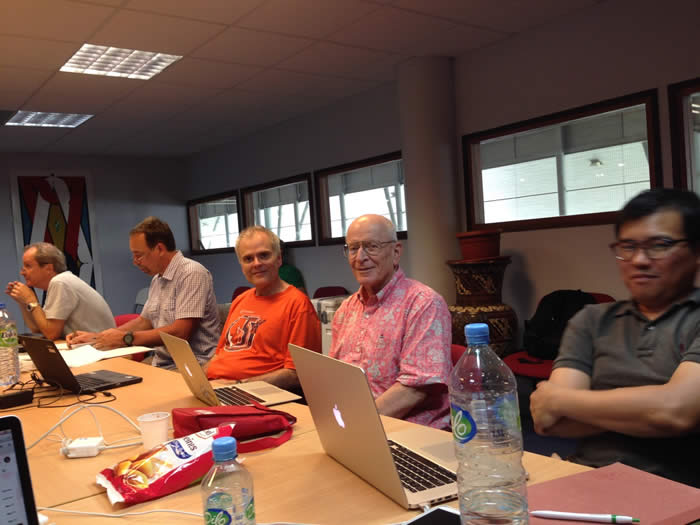
Picture of the Month: Check back each month for a new picture about our group's activities. This month Prof. McFarquhar is shown with research scientist Junshik Um and Prof. Ed Zipser of the University of Utah in the aircraft conference room at the Cayenne Airport in French Guiana. Supported by a grant from the National Science Foundation, they are part of an international consortium conducting a flight campaign to better understand the causes of high ice water contents in the absence of high reflectivity issues. |
 |
Recent Publication: Um, J., G.M. McFarquhar, Y.P. Hong, S.-S. Lee, R.P. Lawson, and Q. Mo, 2015: Dimensions and aspect ratios of natural ice crystals in cirrus. Atmos. Chem. Phys., 15, 3933-3956, doi:10.5194/acp-15-3933-2015. - this paper, written using funding from the Department of Energy, describes how the morphological features of ice particles vary with environmental conditions using data collected in cloud over Alaska, Australia and Oklahoma. In particular, we determined how the aspect ratios (length to width ratios) and distributions of habits varied with temperature, geographic location, and cloud formation mechanism (convective vs. synoptic) |
Greg McFarquhar received his B.Sc. in mathematics and physics from the University of Toronto, Canada in 1987. Thereafter, he changed his field of study to atmospheric sciences and received his M.Sc. (1989) and Ph.D. (1993) from the University of Toronto, specializing in cloud physics. Greg spent two years as a postdoctoral fellow at the Scripps Institute of Oceanography in La Jolla, California (1993-94) and worked at the National Center for Atmospheric Research in Boulder, Colorado (1995-2001) before joining the faculty at the University of Illinois in the fall of 2001. He is the outgoing chair of the American Meteorological Society Committee on Cloud Physics and a member of the International Commission on Clouds and Precipitation. He is the chief editor for the American Meteorological Society's Monographs Collection, an associate editor for the Quarterly Journal of the Royal Meteorological Society and the Journal of Climate, and has active research grants from the National Science Foundation (NSF), the Department of Energy (DOE), and the National Aeronautics and Space Administration (NASA). He has formerly served as Chair of the DOE Atmospheric Radiation Measurement (ARM) program Cloud properties working group, and has been Chief Scientist for the ARM Uninhabited Aerospace Vehicle Program (ARM UAV), the ARM Aerial Vehicle Program (AVP) and the ARM Aerial Facilities (AAF). He was formerly a Richard and Margaret Romano Professorial Scholar at the University of Illinois. He has 107 publications in the refereed literature and has made over 380 presentations at conferences and working group meetings. Interested candidates for graduate studies or postdoctoral positions are encouraged to contact him for more information.
The most fundamental and complex problems in climate and weather research today are our poor understandings of the basic properties of clouds and our inability to determine quantitatively the many effects cloud processes have on weather and climate. Current climate models indicate that Earth's average surface temperature will warm from 1.5 to 4.5°C by 2100 due to increases in greenhouse gases, with the large uncertainty attributed to different treatments of clouds in climate models. Winter weather significantly impacts the transportation and power industries, schools and businesses, and severe thunderstorms can cause significant damage and flooding. Improved quantitative precipitation forecasts require a greater understanding of how cloud processes and the related energy release affect the structure and dynamics of storms. Research within the McFarquhar group addresses the overarching theme of clouds and their relation to climate and weather using a combination of field observations, satellite retrievals and numerical modeling studies.Prof. McFarquhar's work at Illinois aims at making fundamental advances in our understanding of cloud properties and processes, and improving our ability to represent clouds in weather and climate models.
Current projects are advancing our understanding of 1) the microphysical structure of snow bands in winter cyclones; 2) the properties of tropical clouds generated by deep convection; 3) the operating characteristics of probes measuring cloud properties; 4) the transmission of radiation through the cloudy atmosphere; 5) the representation of clouds in climate and weather models; 6) the dependence of arctic cloud properties on aerosol properties; 7) the impact of cloud and aerosol processes on hurricane evolution; and 8) the dependence of fair weather cumuli properties on land-surface and aerosol characteristics. Funding is received from the National Science Foundation (NSF), the Department of Energy (DOE), and the National Aeronautics and Space Administration (NASA) for this research. In the past few years, my graduate students and I have participated in field projects in Darwin Australia (tropical cirrus), Barrow Alaska (arctic mixed-phase clouds), Ponca City Oklahoma (fair weather cumuli and cirrus), Peoria Illinois (winter storms), and Boulder Colorado (performance of cloud probes). Data collected during these projects are being linked with numerical models having a variety of temporal and spatial scales, including cloud resolving, mesoscale and single column models.
| Hurricanes | Cirrus |
Arctic Clouds | Tropical Clouds |
| Snow Bands | Indirect Effects | Radiation Transmission | Probe Operating Characteristics |
Future modeling and observational studies are being planned for Darwin Australia, Salina Kansas, the Galapagos Islands, and the Smokey Mountains in Tennessee. Graduate students and postdoctoral research associates are active collaborators in all projects, presenting their research at conferences and publishing papers in the scientific literature. I am always looking for more students to join my group so that we can improve our knowledge of clouds together.
Current Group
Current Graduate/Undergraduate Students
| Student | Degree |
Topic |
| Amador, Robert | UG | Properties of multi-layer and single-layer arctic clouds |
| Brown, Tyra | M.S. |
Using wavelets to represent ice crystals |
| Choate, Davis | M.S. | Elevated nocturnal convection |
| Crowleyfarenga, Remy | UG | Aerosol effects on hurricane evolution |
| Dong, Jiayin | UG |
Cloud probe intercomparison |
| Duffy, George | M.S. |
Remote sensing of ice clouds |
| Finlon, Joe | M.S. | Retrieving cloud properties in winter storms |
| Haapanala, Päivi (Helsinki) | Ph.D. |
Radiative transfer in cirrus clouds |
| Keeler, Jason | Ph.D. |
Modeling mid-latitude wintertime cyclones |
| Lee, Heewoong | UG | Shape analysis of ice crystals |
| Murphy, Amanda | UG | Microphysics of snowbands |
| Norris, Bethany | Ph.D. |
Microphysics in deep nocturnal convective systems |
| Pham, Casey | UG | Equilibrium raindrop size distributions |
| Rosenow, Andrew | Ph.D. |
Snowbands in mid-latitude cyclones |
| Stechman, Dan | M.S. | Elevated nocturnal convection |
| White, Charles | UG | Dependence of cloud properties on land-surface properties |
| Wu, Wei | Ph.D. |
Representation of ice clouds in climate models |
| Yang, Hee-Jung | Ph.D. |
Indirect effects in trade wind cumuli |
| Zhu, Shichu | M.S. |
High ice water content clouds in Tropics |
Current Postdocs/Staff/Associates
| Individual | Topic |
| Jewett, Brian | Hurricane and mid-latitude cyclone studies |
| Um, Junshik | Cloud/radiative interactions |
Former Students/Postdocs/Staff
| Student | Degree |
Year | Topic | Current Employer |
| Bae, Kenny | M.S. |
2010 | Microphysics of arctic clouds | Wolcott High School, Chicago, IL |
| Birky, Josh | UG |
2002-03 | Lidar observations of clouds | University of South Florida, Tampa, FL |
| Dooley, Amanda | M.S. |
2008 | Hurricane cloud microphysics | Rutgers University, Rutgers, NJ |
| Fitzgerald, Andrea | UG |
2014 | Aerosol effects on hurricanes | University of Illinois, Urbana, IL |
| Freer, Matt | Staff |
2003-07 | Cloud physics probe processing | DMT, Boulder, CO |
| Grim, Joe | Ph.D. |
2008 | MCS microphysics | NCAR, Boulder, CO |
| Guarente, Bryan | M.S. |
2007 | MCS modeling | NCAR, Boulder, CO |
| Guerero, Spencer | UG | 2013 | Characterizing cloud particles as fractals | University of Illinois, Urbana, IL |
| Hampton, Justin | M.S. |
2009 | Mid-latitude snowband properties | Elmhurst College, Elmhurst, IL |
| Hseih, Tsung-Lin | UG | 2011-13 | Techniques for fitting size distributions | Princeton University, Princeton, NJ |
| Jackson, Robert | M.S. |
2011 | Indirect effects in ice clouds | University of Wyoming, Laramie, WY |
| Jackson, Robert | Ph.D. | 2015 | Accuracy of cloud probes | University of Wyoming, Laramie, WY |
| Kim, Sun Kyu | UG |
2013-14 | Image analysis of ice crystals | Seoul, Korea |
| Kruk, Michael | M.S. |
2005 | Bow echo damage patterns | NOAA, Ashville, NC |
| Macomber, Matt | UG |
2013-14 | Frontal structure of mid-latitude cyclone | University of Illinois, Urbana, IL |
| Maliawco Jr., Richard | M.S. |
2012 | Predictability of tropical cyclones | NWS, Montana |
| Mascio, Jeana | M.S. | 2013 | Ice size distributions in tropical cyclones | University of Utah, Salt Lake City, UT |
| Mauno, Päivi | M.S. |
2010 | Radiative transfer in ice clouds (Helsinki) | University of Helsinki, Helsinki, Finland |
| Nousiainen, Timo | Postdoc | 2002-04 | Scattering from small ice crystals | University of Helsinki, Helsinki, Finland |
| Peterson, Melissa | M.S. |
2012 | Stability characteristics of wintertime cyclones | Avmet, Reston, VA |
| Pitcel, Michelle | M.S. |
2010 | Numerical models of gravity waves | University of Illinois, Urbana, IL |
| Plummer, David | Ph.D. |
2014 | Microphysics of snowbands | University of Wyoming, Laramie, WY |
| Rosenow, Andrew | M.S. |
2011 | Snowbands in mid-latitude cyclones | University of Illinois, Urbana, IL |
| Scheff, Jack | UG |
2007-08 | Cloud particles as fractals | University of Washington, Seattle, WA |
| Silver, Amanada | UG | 2011-13 | Rapid intensification of hurricanes | Water Quality Association, Chicago, IL |
| Smith, Andrea | M.S. |
2007 | Microphysics of MCSs | Univ of Northern Colorado, Greeley, CO |
| Timlin, Mike | Staff |
2002-06 | Cloud probe analysis | Midwestern Climate Center, Urbana, IL |
| Turner, Bill | UG | 2013 | Icing conditions in mid-latitude cyclones | University of Illinois, Urbana, IL |
| Um, Junshik | M.S. |
2004 | Cloud-radiation interactions | University of Illinois, Urbana, IL |
| Um, Junshik | Ph.D. |
2009 | Tropical cirrus microphysics/radiation | University of Illinois, Urbana, IL |
| Wang, Hailong | Ph.D. |
2007 | Indirect effects in trade wind cumuli | PNNL, Richland, WA |
| Wegman, Joe | M.S. |
2012 | Electrification of winter storms | NWS, Anchorage, Alaska |
| Weingartner, Fiona | HS |
2010 | History of cloud physics | University of Illinois, Urbana, IL |
| Yaffe, Kyle | UG | 2013 | Automated identification of ice crystals | Scott Air Force Base, Pasquotah, IL |
| Zhang, Henian | M.S. |
2004 | Models of hurricane microphysics | Georgia Dept. of Transport, Atlanta, GA |
| Zhang, Henian | Ph.D. |
2008 | Saharan dust impacts on hurricanes | Georgia Dept. of Transport, Atlanta, GA |