| |
COURSE
ANNOUNCEMENT FALL 2014
ATMS 502, CSE 566:
Numerical Fluid Dynamics
34 students from 10 departments registered so far |
|
|
|
|
Right: Visualization of final course problems
from recent years. |
|
click either animation for full-sized movie |
|
 |
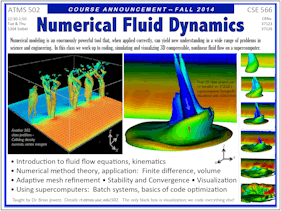
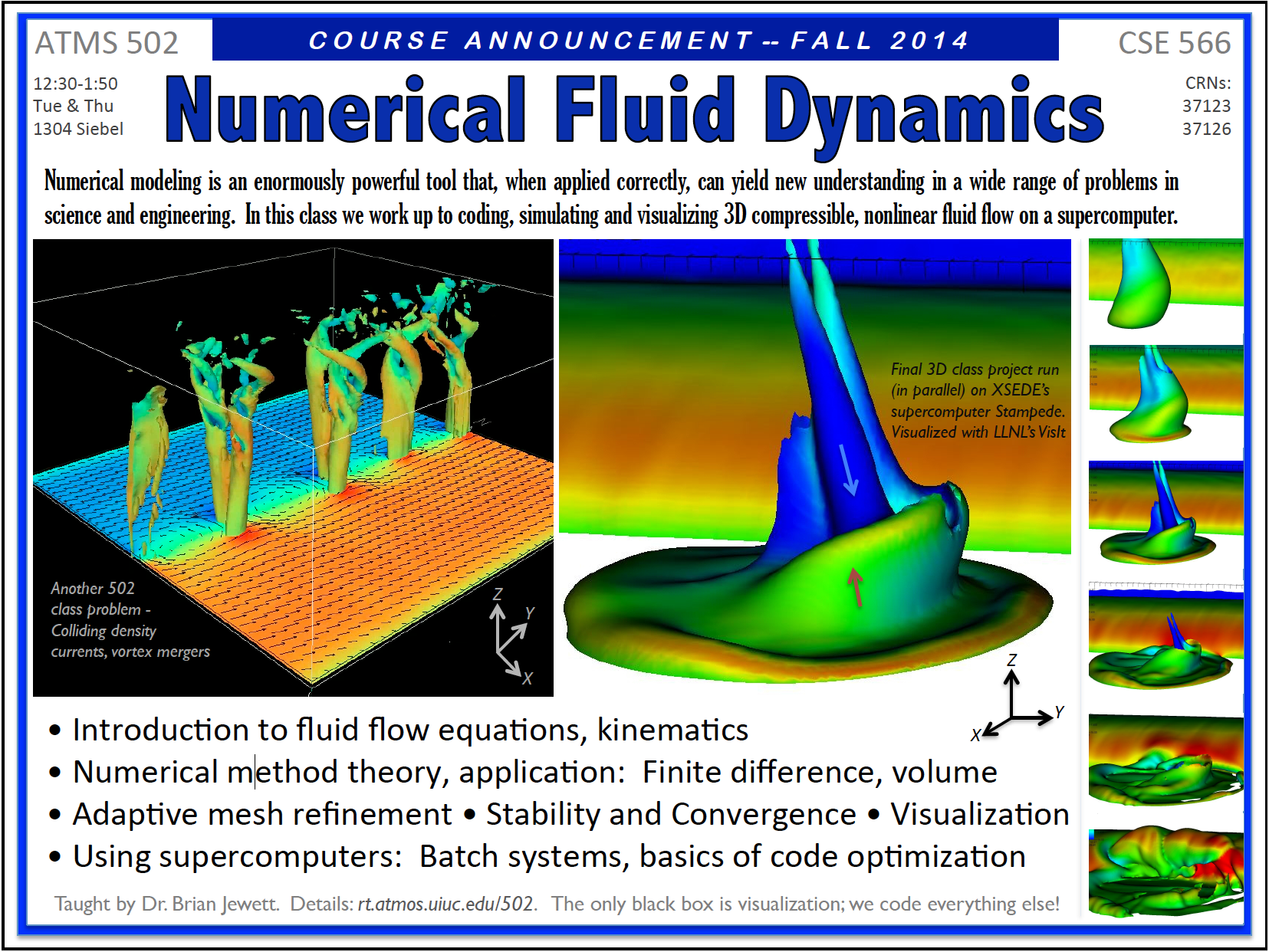
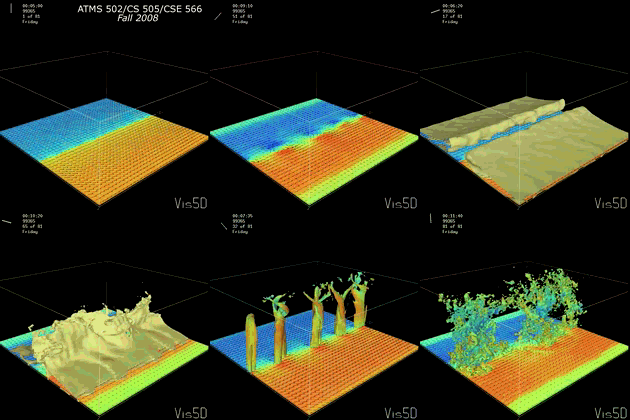
| Shown on left: (1)
surface Y-component winds (shaded, and vectors); (2) potential
temperature surface showing colliding density currents; (3) vertical
velocity (red +, blue -) mapped onto ~0.1/sec vertical vorticity
surface. There are +Y winds (orange) in the right half of the domain,
and -Y (blue) in the left. A vortex sheet develops between colliding
density currents. Small perturbations grow and vorticity is stretched
as convergence and vertical motion concentrate near the center axis.
Merging of nearby vortices results in upscale growth to fewer, larger
rotation centers before the solution decays.
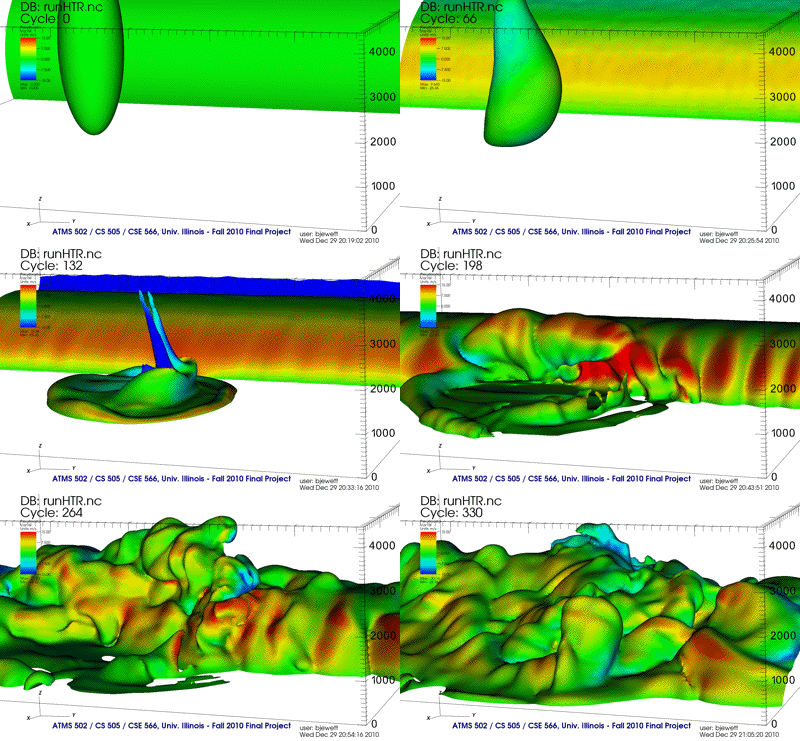
On Right: Movie of last year's
problem, seen with VisIt.
View is ~towards -X, of isosurface of perturbation potential
temperature, with color along the surface representing vertical motion
(scale runs -15 to +15 m/s). A cold thermal descends to the surface
ahead of a descending density current. Shear of the Y-flow component
between the density current, environment, and cold thermal leads to a
rolling up of the vortex sheet, and significant vorticity as it
interacts with the isolated cold source. (Computation, parallelization
and visualization were all parts of the grade).
|
|
FOR: This course is for those interested in numerically
solving partial differential equations that describe
compressible fluid flow,
utilizing a high performance production XSEDE
supercomputer,
likely
Stampede.
KEY OBJECTIVES: that those taking the course leave it with
-
- A thorough understanding of the fundamentals - the basis
for choosing and evaluating numerical methods
- The ability to critically interpret numerical methods as
presented in the literature. We will work through several papers and
examine their descriptions of their methods and how they are assessed
in terms of stability, accuracy, and error characteristics
- Most important: the ability to apply these methods to
high-performance computers. There will be no "black boxes" (other than
visualization
packages) in the
course - the emphasis is on coding and understanding numerical method
behavior as applied to linear and nonlinear fluid flow problems in 1-D,
2-D and ultimately 3-D settings.
- Consequence of the above: That by the end of the course you are very
comfortable with,
and capable of effectively using, supercomputer-class facilities. This
includes
writing and debugging code, compiling and running it, and visualizing
your results. Along
these lines, you will use the "old, slow" way of coding
problems, along with newer
development environments (IDEs)
that are the future.
TOPICS: Our goal is solving fluid flow problems. In so
doing you need awareness of three areas
of study: (1) fluid dynamics and kinematics; (2) programming, data
interrogation, and
visualization, and (3) the numerical methods that tie the first two
areas together. We will discuss, and cover material on, some of
all three areas, including the following.
| Fluid flow |
Coding, data, visualization |
Numerical methods |
| Fluids: Concepts |
Coding: old vs. new; IDEs |
Classes of solution methods |
Flow kinematics
|
Languages, compilers
|
Multi-dimensional problems
|
Fluid flow equations
|
Precision and accuracy
|
Boundary conditions, symmetry
|
Dimensions, units
|
(Super)computers, XSEDE
|
Nonlinear PDEs are fun
|
Compressibility
|
Data and the 4th paradigm
|
Theory vs. practice:
Stability
|
Stability vs. shear
|
Visualization: idioms, tools
|
Systems of equations
|
Simplifications, scaling
|
Debugging efficiently
|
Handling discontinuities
|
Some classic solutions
|
Code optimization basics
|
Initialization; Intro. to data
assimilation
|
COMPUTER PROBLEMS: We will use the XSEDE Stampede
supercomputer to solve fluid flow problems in one, two and three
dimensions, using regular
and nested grid approaches. I will emphasize writing clear and effective programs, as well as
(a bit of) structuring codes for efficient use of parallel computers.
Course assignments may be programmed in either Fortran 90 or C, and
introductory
codes and plotting programs in both languages will be provided.
The behavior of the numerical solutions will be compared to known
solutions when they are available.
The computing objectives are (a) getting everyone comfortable and
familiar with our programming environment on a production
supercomputer, (b)
getting started with 1-D codes before we add complexity, and (c)
working up to 3-D nonhydrostatic nonlinear problems by the end of
class. Each class computer problem will be designed to build on the
last
to make understanding and completing the assignments more
straightforward for all.
PROGRAMMING EXPERIENCE: You should be comfortable with a
programming language, or
ready to learn. This class could be abrupt if you have no programming
experience at all, as we get going fairly quickly. To help everyone get
started and to begin at a common starting point, I will pass out an
introduction (sample) program at the start of class (in Fortran 90 and
also in C) which will serve as a basis upon which you will build your
later programs.
For those rusty in F90 or C (or Linux), there will be review sessions
early in the semester.
However, you might want to consider taking one of the many classes
offered by the University's
Computer Science
and/or CSE
departments to
strengthen your programming skills. The goal here is using a
programming language, rather than learning one.
If you feel your programming experience is not very strong and you
want to do some preparation
before class starts, I recommend the following:
TEXT: There is no single textbook now. I will use books
(there are many) whose material is available free as PDFs online from
the UI library.
INTRO: Welcome; I am Dr. Brian Jewett. I teach
and
carry out research in the Atmospheric Sciences Dept. My specialty is 3d
numerical modeling of a variety of atmospheric phenomena - severe
thunderstorms and squall lines,
hurricanes, and snowstorms.
If you have any questions about the class, please feel free to
contact me.
And remember, fluid modeling and visualization is fun!
(here's another
one).